The Best Time for an Iceland South Coast Tour
When to do a South Coast day tour from Reykjavik: summer midnight sun vs winter northern lights and ice caves, plus month-by-month weather and daylight.
There is no single “best” month for Iceland’s South Coast — there is a best month for you, depending on whether you are chasing long days and green hills or snow, ice caves and a chance of northern lights. The good news is that the classic South Coast day tour from Reykjavik runs year-round, so the waterfalls, the black sand beach and the glacier are on the menu in every season. What changes is the daylight, the weather, the crowds and the bonus experiences you can add on.
This guide breaks the year down honestly — including the trade-offs the brochures gloss over — so you can pick the season that matches your trip.
Summer (June–August): midnight sun and easy travel
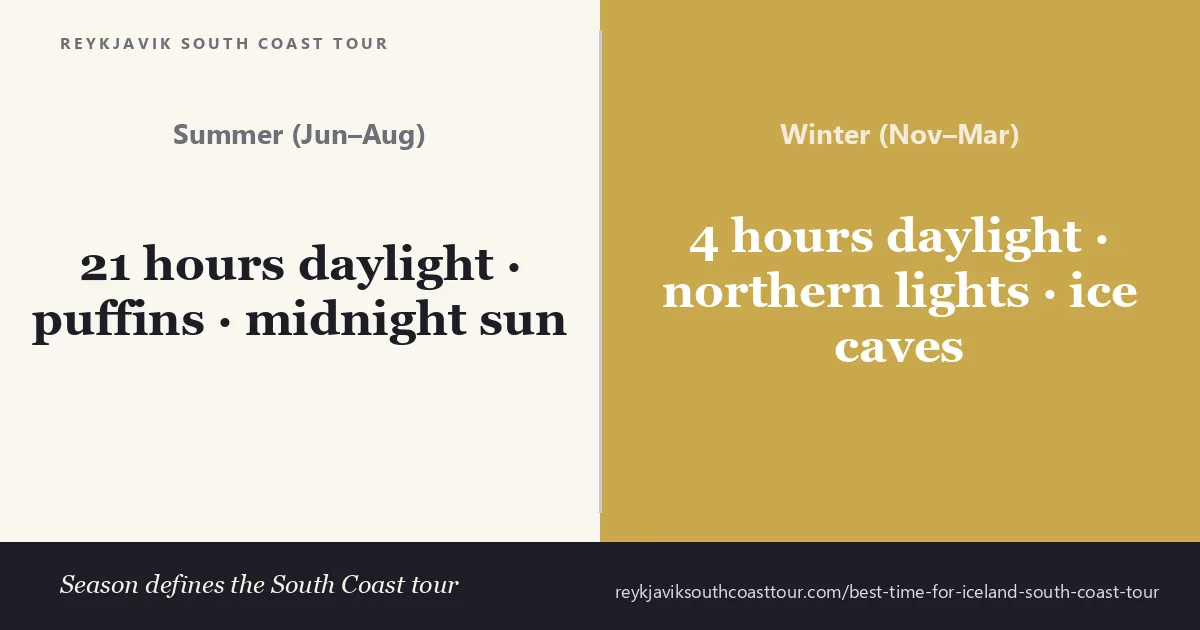
Around the summer solstice in June, Reykjavik gets roughly 21 hours of daylight — close to a true midnight sun. That single fact reshapes the whole tour. A South Coast day that runs about 10–11 hours fits comfortably inside near-endless light, so nothing feels rushed, and the drive back from Vík is in golden evening sun rather than darkness.
Summer pros:
- Longest days, easiest driving. Snow-free roads and bright skies make the long highway stretches to Seljalandsfoss, Skógafoss and Reynisfjara straightforward.
- Green, lush landscapes. Moss-green hills and full waterfalls at peak flow.
- Puffin season. From roughly mid-May to mid-August (June and July are the peak), puffins nest on the South Coast cliffs at Dyrhólaey and around Reynisfjara — a summer-only wildlife bonus.
- Best odds the tour runs as planned. Far fewer weather cancellations than winter.
Summer cons:
- No northern lights. The sky never gets dark enough — the aurora is simply not visible from roughly May through July.
- Busiest stops. Seljalandsfoss and Reynisfjara see their heaviest crowds; early-departure tours help you beat the worst of it.
Winter (November–March): northern lights and ice caves
Winter is the dramatic, high-contrast season. Around the December solstice Reykjavik has only about 4 hours of usable daylight, so a winter South Coast tour is built around that narrow window — another reason departures are early and the pace is brisk. In return you get experiences summer simply cannot offer.
Winter pros:
- Northern lights are possible. The aurora season runs roughly from late September to early April; on the drive home from the South Coast some tours watch for them if the sky is clear. It is never guaranteed, but it is genuinely possible.
- Ice-cave season. The natural blue ice caves inside the Vatnajökull region are only safe to visit in the cold months (roughly November to March). A South Coast itinerary that adds an ice cave is a winter highlight.
- Snowy, cinematic scenery and far thinner crowds at the waterfalls.
Winter cons:
- Very short days and a real chance that weather shortens or cancels a tour.
- The path behind Seljalandsfoss is often closed when it ices over, so you may admire the walk-behind waterfall only from the front.
The Katla ice cave is the year-round exception
One common confusion: not all ice caves are winter-only. The Katla ice cave, in the Kötlujökull outlet of the Mýrdalsjökull ice cap, is accessible to guided tours year-round — volcanic ash insulates it and keeps it stable through summer. So if an ice cave is on your wish list but you are visiting in July, a South Coast tour that adds the Katla ice cave is the way to do it. The natural blue ice caves, by contrast, are the winter-only ones.
Month-by-month at a glance
| Season | Daylight | Crowds | What’s special | Watch out for |
|---|---|---|---|---|
| Jun–Aug | About 18–21 hrs | Highest | Midnight sun, full waterfalls, easy roads | No northern lights |
| Sep–Oct | Shortening fast | Moderate | Aurora season begins, autumn colour | Weather turning |
| Nov–Mar | About 4–7 hrs | Lowest | Northern lights, blue ice caves, snow | Short days, cancellations |
| Apr–May | Lengthening fast | Moderate | Quieter, aurora tail-end (Apr), green returning | Variable weather |
Best time for each highlight
If you’re optimising for one specific thing rather than the whole season, here’s when each draw is at its best:
| You most want… | Best window | Why |
|---|---|---|
| Long days, easy travel | Jun–Aug | Up to about 21 hours of daylight, snow-free roads |
| Northern lights | Late Sep–early Apr | Dark enough skies; aurora season |
| A natural blue ice cave | Nov–Mar | Only safe in the cold months |
| An ice cave in summer | Any month | The Katla ice cave is year-round |
| Fewest crowds | Nov–Mar | Off-season at the waterfalls |
| Full, thundering waterfalls | Late spring/summer | Peak meltwater flow |
| Puffins on the cliffs | Mid-May–mid-Aug | Nesting season at Dyrhólaey and Reynisfjara |
| A glacier walk on Sólheimajökull | Year-round | Offered in every season with a guide |
Note that the waterfalls and the glacier are rewarding in every season — the seasonal decision is really about daylight, the aurora, ice caves and crowds, not about whether the headline stops are “open.”
The shoulder seasons are underrated
If you can’t decide between summer and winter, the shoulder months — late September to October and March to early April — quietly offer the best of both. You still get a reasonable amount of daylight to see the waterfalls and beach comfortably, the crowds are thinner than peak summer, and the nights are dark enough for a genuine chance of northern lights on the drive home. Prices and availability are often easier too. Weather is more variable than midsummer, so the free-cancellation policy most tours offer up to 24 hours before is especially useful in these months.
Why an early departure matters most in winter
Whatever season you pick, South Coast tours leave Reykjavik early in the morning — and in winter that’s not just convention, it’s necessity. With only about four hours of real daylight around the December solstice, an early start is the only way to reach the waterfalls and beach while there’s light to see and photograph them. In summer the early start matters for a different reason: beating the tour buses to Seljalandsfoss and Reynisfjara. Either way, be ready a little before your pickup window.
Checking the aurora forecast and road conditions
A little planning sharpens your odds and keeps the day safe, especially in winter:
- Northern lights. The Icelandic Met Office (vedur.is) publishes an official aurora forecast that pairs an aurora-activity scale with a cloud-cover map — and clear skies matter as much as solar activity. Check it on the day; a strong forecast on the drive home from the South Coast is the best-case winter scenario.
- Roads and weather. Winter weather can close roads or cancel tours at short notice. The Icelandic Road Administration (road.is) shows live road conditions, closures and webcams, and safetravel.is — run by Iceland’s volunteer search-and-rescue teams — carries travel alerts and warnings. On a guided tour your operator monitors all of this for you and will reroute or reschedule if conditions turn, which is one of the quiet advantages of a tour over self-driving in winter.
So when should you go?
- First-time visitor who wants the easiest, greenest trip: June to August.
- Northern lights and snow are the dream: December to February.
- Best of both — some darkness for aurora, but not the deepest winter: late September, October, or March/early April.
- You want an ice cave but are travelling in summer: book the year-round Katla ice cave option.
Whatever the season, the South Coast is a long day — pack for changeable weather and consider a small-group tour if you prefer a slower pace and more time at each stop. For the full picture of what you’ll see and how to choose, start on our South Coast tour homepage.
Ready to Book?
The classic South Coast day from Reykjavik covers Seljalandsfoss, Skógafoss, Reynisfjara black sand beach and a glacier, with hotel pickup, a driver-guide and free cancellation up to 24 hours before. It’s rated 4.8/5 by more than 11,000 travellers and runs in every season.
See Iceland's South Coast — From $129
Join 11,000+ travelers who rated this South Coast tour 4.8/5. Waterfalls, the black sand beach and a glacier, with Reykjavik hotel pickup and a driver-guide — free cancellation up to 24 hours before.
Check Availability & Book